
Is Pain With Peyronie’s Disease Normal and How Long Does It Last?
Pain associated with Peyronie’s disease is one of the most common symptoms men notice when penile curvature develops.
One of the first questions men ask when they notice a curvature of the penis is very simple: is the pain normal?
Many men notice that erections start to become painful.
Sometimes the pain is mild and tolerable. Sometimes it can be severe enough to make sexual intercourse difficult or even impossible.
In some cases, the pain occurs only occasionally, while in other men it becomes a persistent problem.
This often causes concern, fear, and uncertainty.
The fact is that pain is one of the most common symptoms of Peyronie’s disease, especially during the early stage of the condition.
In other words, pain is not unusual.
However, it is a sign that an active process is taking place within the tissues of the penis.
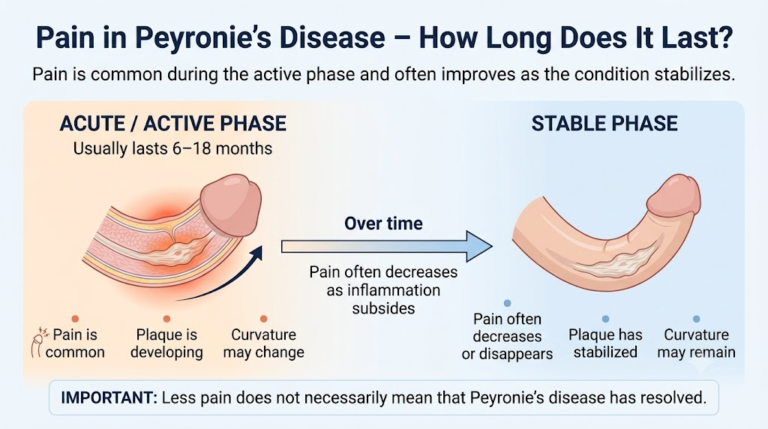
How Long Does Pain With Peyronie’s Disease Last?
Why Does Peyronie’s Disease Cause Pain?
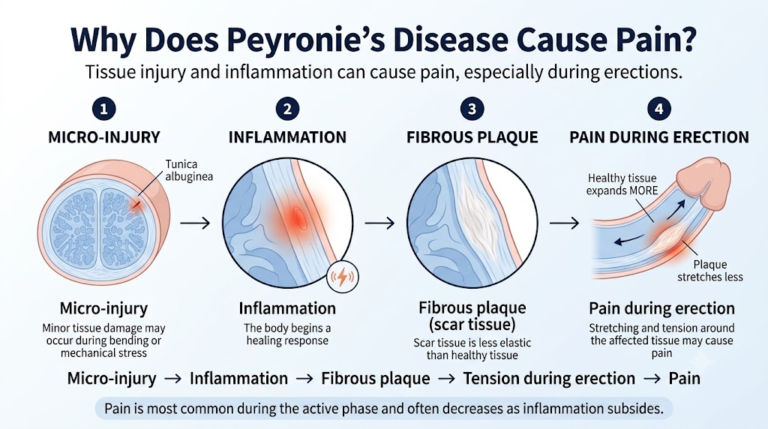
Pain occurs because of tissue damage and inflammation within the penis.
As we have already explained, Peyronie’s disease develops when fibrous plaque forms inside the penis – scar tissue that develops after an injury.
This injury often occurs during an erection. At that time, the penis is rigid, filled with blood, and more vulnerable to bending.
If sudden pressure, bending, or a micro-injury occurs, it can cause minor internal bleeding.
The body then attempts to repair the damage.
However, sometimes the healing process does not proceed normally. Instead of healthy, elastic tissue, hard scar tissue known as plaque develops.
This process can cause inflammation. And where there is inflammation, there is often pain.
Pain is most commonly felt during an erection because the penis expands and stretches, while scar tissue does not have the same elasticity as healthy tissue.
When Does Pain Most Commonly Occur?
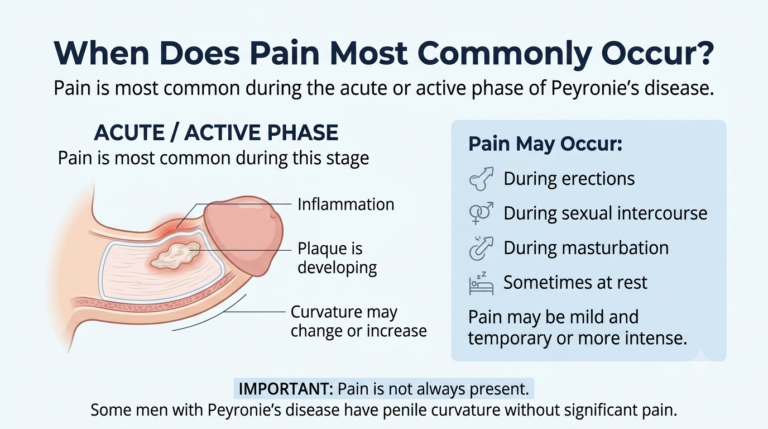
Pain most commonly occurs during the acute phase of Peyronie’s disease.
This is the early stage of the condition, during which several changes may occur:
- inflammation of the tissue
- plaque formation
- changes in the shape of the penis
- increasing curvature
During this period, the penis may be sensitive. The tissue is inflamed and can react to tension or pressure.
Many men notice pain:
- during an erection
- during sexual intercourse
- during masturbation
- sometimes even when the penis is at rest
In some men, the pain is mild and temporary. In others, it can be very intense.
It is important to note that pain is not always present.
Some men have penile curvature but have never experienced significant pain.
How Long Does the Pain Last?
Pain usually occurs during the acute phase of Peyronie’s disease.
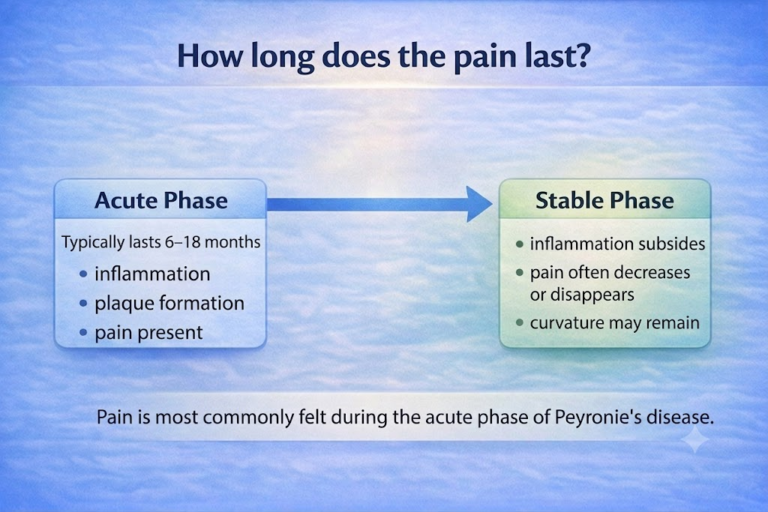
This phase typically lasts between 6 and 18 months.
During this time, the plaque develops and gradually stabilizes. As the inflammation subsides, the pain usually decreases.
In most men, the pain gradually improves or disappears over time.
However, this brings us to an important point that many men misunderstand.
The disappearance of pain does not mean that Peyronie’s disease has disappeared.
The pain may go away, while the penile curvature may remain.
Why Does the Pain Go Away While the Curvature Remains?
When the inflammation subsides, Peyronie’s disease enters the stable phase.
During this phase:
- inflammation is no longer active
- pain usually decreases or disappears
- the plaque remains in the tissue
- the curvature usually stabilizes and may persist
In other words, the tissue “settles down,” but the deformity may remain.
This is why many men think the problem has resolved when the pain goes away, only to realize later that the penis is still not as straight as it was before.
Pain is primarily associated with the active inflammatory process.
Curvature is caused by fibrous scar tissue that does not stretch like healthy tissue.
Can the Pain Become Chronic?
In most cases, the pain is not permanent.
For most men, pain decreases as Peyronie’s disease progresses from the acute phase to the stable phase. However, there are exceptions.
Pain may persist longer if:
- the plaque is large
- the curvature is severe
- inflammation remains active
- multiple plaques are present
In such cases, pain may last longer or occasionally return.
It is also possible for the pain to disappear and then return later, particularly if a new injury or additional trauma to the penis occurs.
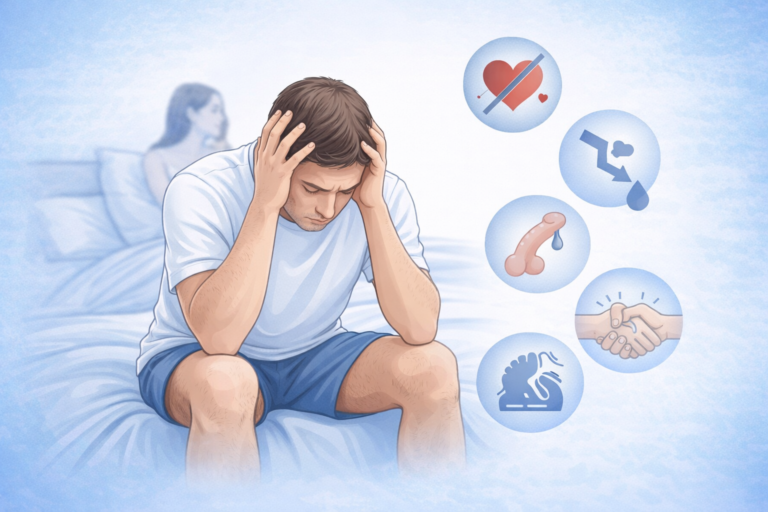
Pain and Psychological Impact
Pain is not only a physical problem. It can also have a significant psychological impact.
Men who experience pain during erections may begin to avoid sexual activity. Fear of pain, insecurity, and loss of self-confidence can gradually develop.
Over time, this may lead to:
- avoidance of intimacy
- reduced sexual desire
- erectile difficulties
- tension in a relationship
It is important to understand that these reactions are common.
Many men with Peyronie’s disease go through similar experiences.
When Should You Be Concerned?
If you notice any of the following symptoms, it is a good idea to seek medical advice and learn more about the available options:
- pain during erections that persists for a prolonged period
- gradually increasing penile curvature
- a hard lump or plaque that can be felt in the penis
- difficulty during sexual intercourse
The sooner you understand what is happening, the easier it is to make an informed decision about the next steps.
Ignoring the problem often only prolongs uncertainty and frustration.
Conclusion
Pain associated with Peyronie’s disease is not uncommon. It is most often associated with the acute phase of the condition, when inflammation is active and fibrous plaque is developing.
During the acute phase, which typically lasts 6 to 18 months, pain often gradually decreases and may eventually disappear.
However, the disappearance of pain does not mean that Peyronie’s disease has resolved. In many cases, penile curvature may remain even after the pain has completely disappeared.
Understanding the cause of the pain and how Peyronie’s disease progresses is an important first step toward making informed decisions about what to do next.
Do You Have Pain With Peyronie’s Disease and Wonder If It Is Normal?
Pain can occur with Peyronie’s disease, especially during the earlier stages of the condition. If you have questions about how long the pain may last, changes in curvature, the different stages of the disease, or when to consider the next steps, feel free to contact me discreetly by message.
I reply to every message as soon as possible. Available on weekdays from 8:00 AM to 5:00 PM (CET/CEST). Mobile: +385 91 633 23 70