
Can Peyronie’s Disease Go Away on Its Own?
One of the first questions a man asks when he notices penile curvature is: will it go away on its own?
Will it straighten without treatment, without surgery, without doing anything at all? Or will it remain permanently?
How Does Peyronie’s Disease Develop?
Peyronie’s disease, or penile curvature, develops when the tissue of the penis is damaged and plaque (a lump of scar tissue) forms at the affected area. This injury is often not visible from the outside.
A man may not remember any specific injury or event, but during an erection he notices that his penis is no longer as straight as it used to be. It may curve upward, downward, to the left, or to the right – depending on where the plaque has formed.
Early Stage – Wait or Take Action?
In the early stage, the condition may be mild. The curvature may be slight, and pain may occur occasionally or not at all. This is precisely when most men decide to wait. They hope that the body will heal on its own and that the penis will straighten naturally.
But is that realistic?
Stages of the Disease and the Possibility of Spontaneous Improvement
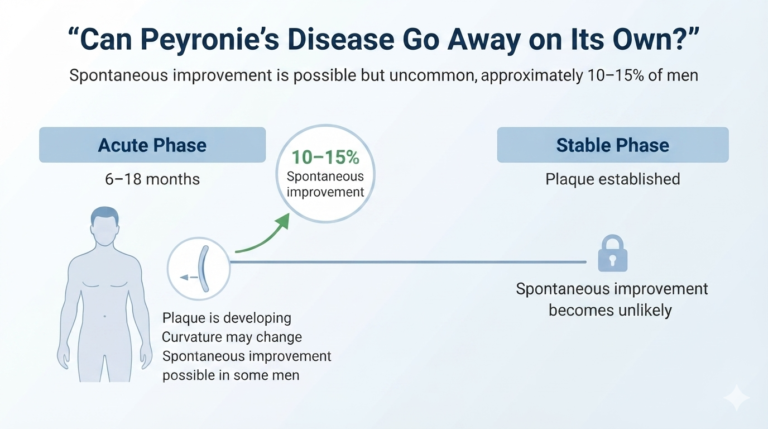
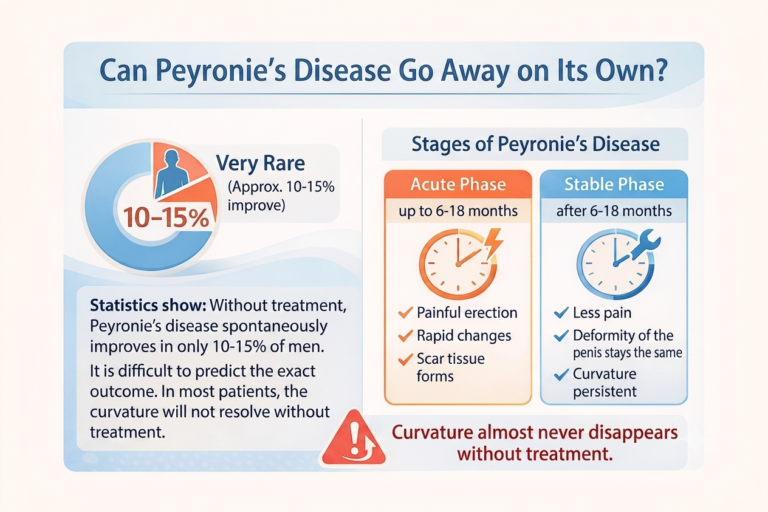
Peyronie’s disease progresses through different stages. During the first, known as the acute phase, plaque forms and the shape of the penis may change.
This phase can last from 6 to 18 months. During this period, the condition has not yet stabilized, and the curvature may continue to change.
In a small number of men, some spontaneous improvement may occur during this phase. However, it is important to understand that this is the exception rather than the rule.
Statistically, spontaneous improvement occurs in approximately 10–15% of men. In most cases, the condition either remains unchanged or worsens over time. Once the disease enters the stable phase and the plaque becomes established, the likelihood of the curvature improving on its own becomes very low.
Why Doesn’t Scar Tissue Go Away on Its Own?
Why? Because we are dealing with scar tissue. Scar tissue does not return to normal, elastic tissue on its own. It may soften and become less painful, but it does not disappear without intervention.
It’s Not Just a Cosmetic Problem
A curved penis is not just a cosmetic issue. It can also be a functional and psychological problem.
During an erection, the plaque can prevent the affected tissue from expanding normally. This may lead to pain, weaker erections, shortening of the penis, and difficulty with sexual intercourse.
When the Pain Goes Away but the Problem Remains
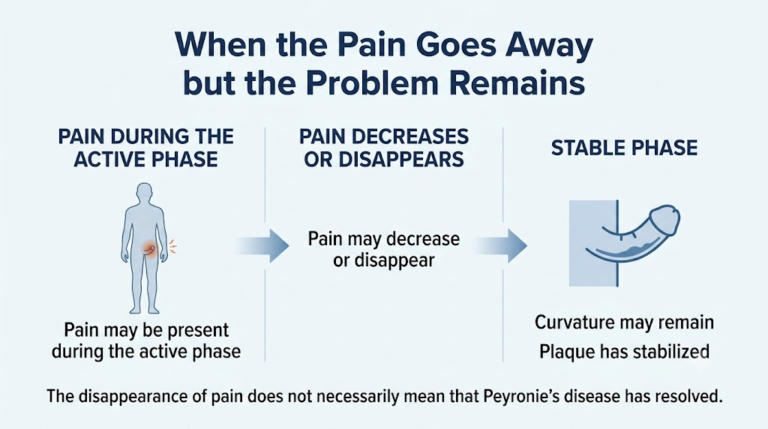
In some cases, the pain goes away, but the curvature remains. This can be confusing. A man may think the problem has resolved because he no longer feels pain. In reality, the disease has simply progressed to the stable phase.
Can It Go Away Without Treatment?
Can Peyronie’s disease go away on its own? It can, but this is uncommon. In most cases, without intervention, the condition persists.
Waiting without monitoring or treatment may mean missing an opportunity to take action earlier, while the plaque is still developing and the condition has not yet stabilized.
Time Plays a Key Role
Many men avoid seeing a doctor because of embarrassment or fear. Some hope that the condition will simply go away on its own. However, timing can play an important role. The earlier the condition is assessed and addressed, the greater the opportunity to consider appropriate treatment options and potentially improve the outcome.
Conservative Treatment Options in the Early Stage
In the early stage of the disease, conservative treatment options may be considered. Some therapies may help slow progression, reduce curvature, and improve penile function.
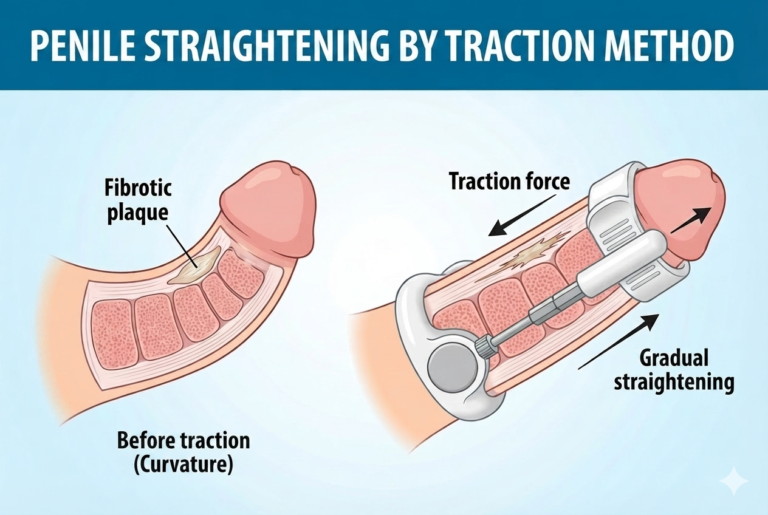
One approach increasingly discussed in medical practice is controlled penile traction, which involves gradually stretching the penis using a traction device with carefully controlled tension.
The Principle of Traction
The principle of traction is nothing new. Throughout history, various cultures have used stretching techniques to gradually alter the shape of different parts of the body.
When applied in a controlled and consistent manner, traction can stimulate tissue adaptation and remodeling. In the penis, this process may improve tissue flexibility and, over time, help reduce curvature.
How Does the Penisal Device Work?
Penisal uses this very principle. With regular and proper use, traction stimulates tissue adaptation and remodeling and may gradually improve flexibility in the area affected by plaque. The goal is not a sudden change, but gradual correction over time.
Not Every Penile Curvature Is Peyronie’s Disease
It is important to emphasize that not every penile curvature is Peyronie’s disease. Some men have congenital penile curvature that remains stable and does not progress over time.
However, if the curvature has developed recently, is accompanied by pain, or becomes more pronounced over time, Peyronie’s disease may be the cause.
Painful Erections as an Early Sign
Painful erections are often one of the first signs. At first, the pain may be mild, but as the condition progresses, erections may become increasingly uncomfortable. In later stages, sexual intercourse may become difficult or even nearly impossible.
Conclusion
So, can Peyronie’s disease go away on its own? It is possible, but you should not rely on spontaneous improvement as a solution. It is safer to stay informed, monitor the condition, and seek appropriate advice when needed.
Ignoring the problem is not a strategy. Early assessment may provide more options for managing the condition. If you notice a change, do not panic, but do not ignore it for years either. Learn about the condition, seek professional advice, and consider the available treatment options before the condition becomes stable.
Penile curvature does not mean the end of your sex life, but it can be a sign that something has changed in the penile tissue. Understanding those changes early can help you make informed decisions about what to do next.
Wondering if Peyronie’s disease can go away on its own?
In some men, symptoms may change over time, but it is important to understand what is happening, which phase you are in, and when it may make sense to consider a non-invasive approach. If you have any questions or concerns, feel free to contact me discreetly by message.
I reply to every message as soon as possible. Available on weekdays from 8:00 AM to 5:00 PM (CET/CEST). Mobile: +385 91 633 23 70