
Acute vs. Stable Phase – What Is the Difference?
The acute phase is the initial phase of the disease.
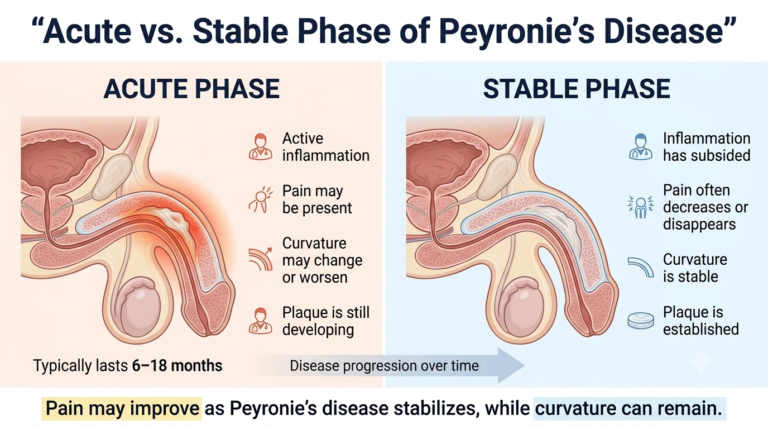
It usually lasts between 6 and 18 months. In some men, it may be shorter, while in others it may last longer, but in general, this is the period of active inflammation and ongoing changes.
Many men first seek information about the condition because they experience painful erections.
During this phase, the curvature has not yet stabilized. It may change. It may progress. It may become more pronounced from month to month.
Some men notice that the penis curves upward, while others experience a downward or sideways curvature. In more severe cases, an “hourglass” deformity may develop, where part of the penile shaft becomes narrowed.
The psychological impact during this phase can be significant. A man may experience pain, notice physical changes, and feel uncertain about what to expect.
The most important thing to understand is that the acute phase is a period of active disease. The body is responding to tissue injury. Inflammation is present, and the plaque is still developing.
What happens during the acute phase?
Several key changes occur during the acute phase:- active inflammation develops in the penile tissue
- fibrous plaque begins to form
- penile curvature may gradually increase
- erections may become painful
- erectile rigidity may decrease
Many men first seek information about the condition because they experience painful erections.
During this phase, the curvature has not yet stabilized. It may change. It may progress. It may become more pronounced from month to month.
Some men notice that the penis curves upward, while others experience a downward or sideways curvature. In more severe cases, an “hourglass” deformity may develop, where part of the penile shaft becomes narrowed.
The psychological impact during this phase can be significant. A man may experience pain, notice physical changes, and feel uncertain about what to expect.
The most important thing to understand is that the acute phase is a period of active disease. The body is responding to tissue injury. Inflammation is present, and the plaque is still developing.
What Actually Happens Inside the Penis?
To understand the difference between the acute and stable phases, we first need to understand what happens inside the penis.
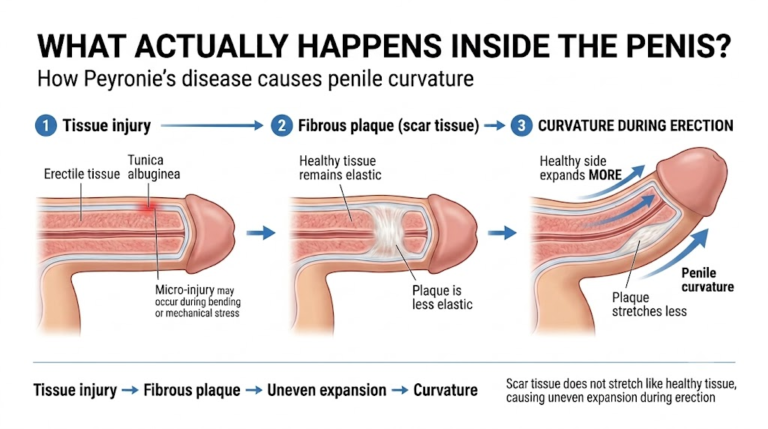
Peyronie’s disease develops when the tissue of the penis is injured. This damage most often occurs during an erection – during sexual intercourse, masturbation, or sudden bending of the penis. The injury does not have to be visible from the outside. It does not have to be dramatic either. Sometimes even minor internal bleeding is enough.
The body responds by forming scar tissue – known as plaque.
Plaque is hard, fibrous tissue that does not have the same elasticity as healthy tissue. When the penis fills with blood during an erection, the healthy tissue expands. Scar tissue does not expand. And that is precisely why curvature develops. It is a mechanical problem. But Peyronie’s disease progresses through different phases.
Peyronie’s disease develops when the tissue of the penis is injured. This damage most often occurs during an erection – during sexual intercourse, masturbation, or sudden bending of the penis. The injury does not have to be visible from the outside. It does not have to be dramatic either. Sometimes even minor internal bleeding is enough.
The body responds by forming scar tissue – known as plaque.
Plaque is hard, fibrous tissue that does not have the same elasticity as healthy tissue. When the penis fills with blood during an erection, the healthy tissue expands. Scar tissue does not expand. And that is precisely why curvature develops. It is a mechanical problem. But Peyronie’s disease progresses through different phases.
ℹ️
Not Sure Whether You’re in the Acute or Stable Phase?
Understanding the difference between the acute and stable phases of Peyronie’s disease can be important when evaluating symptoms, pain, changes in curvature, and when to consider the next steps. If you have any questions or concerns, feel free to contact me discreetly by message.
I reply to every message as soon as possible. Available on weekdays from 8:00 AM to 5:00 PM (CET/CEST). Mobile: +385 91 633 23 70